
Wire-free robot lawn mowers: RTK, LiDAR and vision, and when a wire still wins
Wire-free robot mowers find the lawn edge with satellite corrections (RTK, from a base in your yard or over a network), with LiDAR, with cameras, or with some mix of those. The right approach depends on how much open sky the lawn has, how clear its edges are, and whether you have network-RTK coverage. A wired mower is still the better call in some yards.
We may earn a commission if you buy through our links.
Quick research picks
Mammotion
LUBA 3 AWD 3000
A terrain-focused wire-free option, with LiDAR, satellite corrections and vision working together. Capacity changes by SKU; reserve space matters more than the family name.
Watch-out: The 3000’s advertised acreage is below a full acre before adding reserve.
We may earn a commission if you buy through our links.
Scroll sideways to see all columns.
| Model / US variant | Navigation / drive | Ongoing data | FCC / US availability | |||
|---|---|---|---|---|---|---|
| Mammotion LUBA 3 AWD 3000MTLA25LU33KNA | 0.75Source · 2026-11-06 | 80% (38.7°)Source · 2026-11-06Boundary: 40% (21.8°) | 360° LiDAR + NetRTK + dual-camera visionAWD · Wire-free | Renewal cost unknown3 years of stated service included | $1,999Brand · 2026-11-10Check price at Amazon | Exact-SKU authorization unverifiedUS listing found — stock check neededWhat this means |
Setup and trade-offs
Mammotion LUBA 3 AWD 3000
Choose if: You need AWD and several navigation methods for a lawn comfortably below the exact variant’s area rating.
Skip if: You need a confirmed full two-acre solution: the US LUBA 3 variants checked here do not provide that capacity.
Trade-off: The 3000’s advertised acreage is below a full acre before adding reserve.
Setup: Read the exact-SKU manual, confirm dock and navigation requirements, and check the route between each mowing zone before ordering.
Check price at Mammotion ↗| Metric | This SKU | Database average |
|---|---|---|
| Rated acres | 0.75 | 1.24n = 15 |
| Working slope | 80% (38.7°) | 66.9% (33.8°)n = 15 |
Averages use one variant per model family with a published figure. See the full database.
This SKU: us.mammotion.com, accessed 2026-11-06.
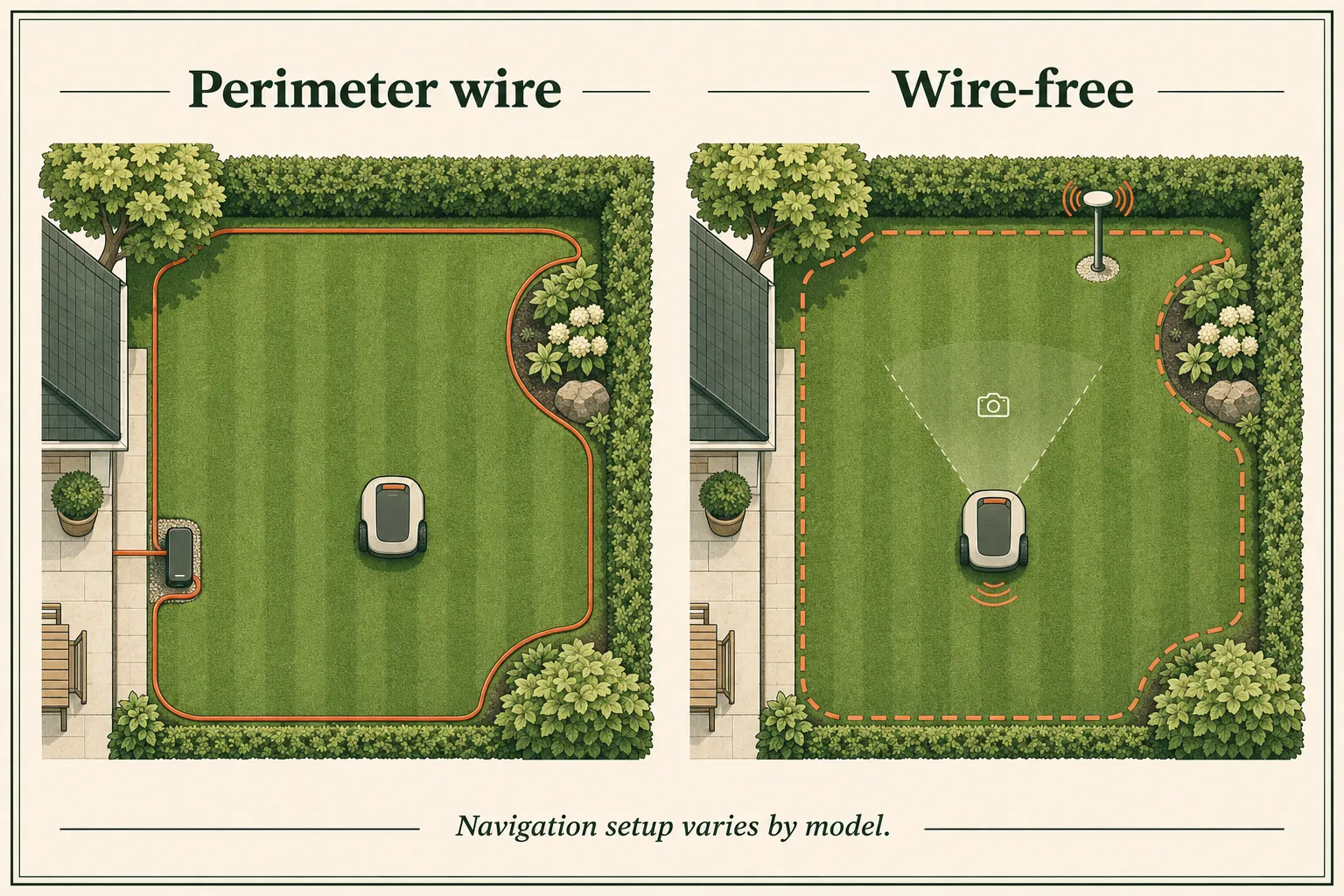
What replaces the boundary wire
A wire-free robot mower still has to know where the lawn ends. It does that in one of three ways, and many models combine them:
- Satellite corrections (RTK). A receiver on the mower uses correction data from a reference station in your yard, or from a network of stations, to refine its satellite position.
- LiDAR. The mower maps nearby surfaces with a laser scanner. Some models claim they do not need a GPS or RTK setup for that job.
- Cameras, or vision. The mower tells grass from non-grass, or builds a visual map, without a buried loop.
The right approach depends on how much open sky the lawn has, how clearly its edges read as grass against something else, and whether a network-RTK service covers your address. Skipping the perimeter wire doesn’t skip installation: you still need power, a charging spot, a map or recognizable edges, and, on some systems, a base station, a coverage check or a paid data plan after a free period.
The card on this page is the one example with a product record that you could actually order on November 10, 2026: the Mammotion LUBA 3 AWD, which combines LiDAR, network RTK and cameras. The other approaches are covered in the table and the prose. The Navimow X4, the network-RTK example, was sold out as of November 10, 2026, so it has no card and no Amazon button. The LiDAR example is the Ecovacs GOAT A3000 LiDAR PRO, which has no product record on this site yet and is described only in the prose, with a brand link. The original non-PRO A3000 LiDAR is a different variant and was sold out at Ecovacs US that day; it isn’t used as the example.
Spec-compared from manufacturer manuals, spec sheets and FCC records. We have not tested these mowers hands-on.
This page is the category chooser: which approach suits the yard, what it costs to run, and when a wire is still the better call.
The approaches, side by side
Each cell is taken from the maker’s US page or US manual, or from the NOAA National Geodetic Survey’s 2011 RTK guidance, which is survey advice rather than a mower test. Stock lines are from the brand stores on November 10, 2026, and aren’t a claim about every US seller. Slope conversions use percent first, with degrees in brackets (our arithmetic unless the maker printed both).
| Approach | What it needs from your yard | Documented limits | Ongoing cost | Example (stock, Nov 10, 2026) |
|---|---|---|---|---|
| RTK with a local base | Open sky at the reference station and over the lawn | Large canopies can cause stops; virtual boundary at most 15% (8.5°) on the 410 iQ | Husqvarna states a 10-year data contract for Automower Connect | Husqvarna Automower 410 iQ: $2,599.99 MSRP, out of stock at Husqvarna US |
| Network RTK | Cellular service and network-RTK coverage at your address, plus sky view | Coverage is address-specific; check before you buy | Varies by maker; see the cost section below | Navimow X430 (Navimow pairs network RTK with 360° vision): $2,499, sold out as of Nov 10, 2026 |
| LiDAR | Line of sight to nearby structures; the PRO manual says to build the map in daylight | Virtual boundary at most 20% (11.3°) on the GOAT A3000 LiDAR PRO | None stated in the sources we opened | Ecovacs GOAT A3000 LiDAR PRO: $2,499.99, in stock at Ecovacs US |
| Vision only | Clear grass / non-grass edges | A lawn that runs into a neighbor’s needs a magnetic strip or a grass-free gap; edge slopes over 30% (17°) are a struggle | None stated | Worx Landroid Vision WR220: price and stock not shown on the US page |
| Fusion (LiDAR + network RTK + vision) | A mix: sky for RTK, and nearby features for LiDAR and cameras | Maker claims only; owner reports describe signal-related failures on some fusion and network-RTK machines | LUBA 3: 4G subscription after 3 years | Mammotion LUBA 3 AWD 3000 Standard: $1,999, available at Mammotion US |
| Physical boundary wire | A buried or pegged loop around the work area | Install effort; no sky view or network needed for the boundary itself | None for positioning | Husqvarna Automower 435X AWD: $2,999.99 MSRP, in-store only |
Two conflicts belong next to those cells, not averaged out. The Husqvarna 410 iQ US page states 45% slope inside the installation; the 410iQ/420iQ/440iQ manual says “The product can operate in 40% slopes.” Both figures sit well above the 15% virtual-boundary cap. The Ecovacs PRO US page states a 50% (27°) work-area slope; the US manual tells owners to set No-Entry Zones for slopes over 45%.
Mostly open sky and a dependable signal: RTK, local or network. Heavy canopy or buildings close to the lawn: look at LiDAR or vision, or keep a wire in the shaded zones as Husqvarna itself suggests. Clean grass-to-hard edges and a small, flat lawn: vision only. Steep ground: compare each model’s edge figure; all-wheel drive, not the wire, is what raises it.
When a wired mower is still the better call
Brand pages rarely say this, so it’s worth being plain. A physical boundary wire is still the better call when the yard doesn’t give the wireless systems what they ask for, or when the wired model’s documented limits are the ones that actually fit.
Husqvarna, which sells both, describes EPOS as “perfect for homeowners with large, open yards with clear sight of the sky,” and adds that owners can “utilize some boundary wire in areas of heavy shade.” The 410 iQ manual is more specific: the work area must have “unimpeded sky view,” and trees with canopies more than 13 ft (4 m) in diameter can cause temporary stops, so those areas should be stay-out zones. Husqvarna’s EPOS page says the reference station itself needs a clear 135-degree sky view. Cloud EPOS “requires a constant internet connection,” and Husqvarna says its cloud coverage “is not the same as cellphone coverage.”
A neutral survey source explains why sky view keeps coming up. NOAA’s National Geodetic Survey, in its 2011 user guidelines for single-base RTK, describes centimeter-level positions relative to a fixed base, and says a rover “obstructed by trees or buildings” has its signals interrupted and must go through “a re-initialization process.” That’s survey-grade guidance from 2011, not a mower test, but it’s the same physics the manuals are warning about.
The wired Husqvarna Automower 435X AWD states higher slope limits than the EPOS 410 iQ: 50% (26.6°) at the boundary and 70% (35.0°) inside, against 15% (8.5°) at the virtual boundary and 45% (24.2°) on the 410 iQ page (or 40% (21.8°) in the manual). That gap comes with all-wheel drive, not with the wire: Husqvarna’s wire-free EPOS 435 iQ AWD lists the same 50% and 70% on its US page ($4,999.99 MSRP, available online as of November 10, 2026). What the wire changes is that the 435X needs no sky view or network to hold its loop. It was listed at $2,999.99 MSRP and in-store only as of November 10, 2026; dealer stock was not checked.
If you already have a stable wired system, or the entire lawn sits under a heavy canopy, staying wired, or choosing a wired model such as the 435X, is a legitimate outcome. So is keeping a conventional mower.
Examples, with dated stock
Network RTK: Navimow X4 (X430 $2,499 and X450 $2,999, sold out as of November 10, 2026). Navimow describes the X4 as using “Tri-frequency Network RTK combined with 360° VSLAM and VIO.” Navimow groups this as “Dual-fusion Positioning (NRTK + 360° Vision)”, so it isn’t a pure network-RTK machine. A physical RTK antenna is included for optional installation. Where network RTK coverage is available, the page says there is no need to install a local antenna, and that network RTK access is included at no extra cost, with the required cellular data provided free of charge. A ZIP code checker is on the page; coverage is address-specific, so use it before you buy. Connect+, the 4G app service, is a separate item: 1 year free on the X430 or 2 years on the X450, then $32.90 a year. It isn’t shown as a card because it was sold out at navimow.com and on Amazon on November 10, 2026. That is a stock date, not a statement that the series has been discontinued.
LiDAR: Ecovacs GOAT A3000 LiDAR PRO ($2,499.99, in stock at Ecovacs US as of November 10, 2026). Ecovacs names the PRO’s navigation “Multiline LiDAR.” The US page says “No GPS setup is required” and that it works “even under trees or near buildings”; those are maker claims, not independent test results. The US page rates the work-area slope at 50% (27°) and the virtual-boundary slope at 20% (11.3°). The US manual says “Do not create the virtual boundary on a slope that exceeds 20%,” tells owners to set No-Entry Zones for slopes that exceed 45% (24.2°), and says to “Build the map at daytime under optimal sunlight.” The same manual gives a working capacity of about 3/4 acre (3,000 m²). The original non-PRO A3000 LiDAR (a different navigation description, “Dual LiDAR + Camera”) was sold out at Ecovacs US as of November 10, 2026, and isn’t the example. We haven’t added an Amazon link for the PRO.
Check price at Ecovacs (GOAT A3000 LiDAR PRO, $2,499.99, in stock at Ecovacs US as of November 10, 2026; direct link, no commission to us).
Vision only: Worx Landroid Vision WR220 (price and stock not shown). The US manual says the camera tells the working area from the non-working area, with no boundary wire and no virtual boundary. The documented limits are Worx’s own: grass-covered steps over 1.2 in (3 cm, our conversion) at the edge are not seen, so you leave a grass-free path wider than 2 in (5 cm); a lawn that is connected to a neighbor’s cannot be separated without the magnetic strip or a grass-free gap over 2 in (5 cm); and “If your lawn edge has a steep slope higher than 30% (17°), Landroid Vision will struggle.” The US page states a maximum slope of 17° (30%). The same page disagrees with itself on area: the spec table says “Recommended lawn size 1/2 Acre,” while the body text says “Reliably covers areas up to 1/5 acre (8,712 sq. ft.).” We show both and don’t pick one. We also can’t state a price or a stock status, because the page rendered prices as placeholders on November 10, 2026.
Fusion: Mammotion LUBA 3 AWD 3000 Standard ($1,999, available at Mammotion US as of November 10, 2026). This is the in-stock variant, and the card on this page. Mammotion describes “Tri-Fusion Positioning (360° LiDAR + NetRTK + Dual Camera AI Vision),” with NetRTK via iNavi and “no antenna or setup needed.” Mammotion advertises “Lifetime Free iNavi Service” and calls NetRTK “free for the entire product lifecycle,” while its US LUBA 3 page labels iNavi “Based on 4G Service” and says the 3 years of free 4G data then need a subscription. Mammotion’s official US iNavi article (visible date July 1, 2026) says the mower “connects to the network via WiFi or 4G” and “If the 4G plan is not renewed, iNavi positioning can still function with WiFi and 4G”; it doesn’t mention a hotspot, or how far your Wi-Fi needs to reach. Those are maker claims. The 1500 is described as positioning “without RTK/NetRTK” up to 0.37 acre, which is a different variant and was sold out that day. Mammotion’s 2026 iNavi compatibility list names only the 3000, 3000H, 5000 and 5000H. The 3000 and 5000 US box also includes an RTK station. After 3 years of free 4G, “a subscription is required,” at $19.90 for 3 months or $49.90 for 12 months. The 3000H, 5000 and 5000H were sold out as of November 10, 2026. Choose the 3000 if a fusion system at this price and size fits, and budget for the 4G plan after year three if you want those cellular features. Skip it if you wanted only a local base or only a camera, or if you need a variant that wasn’t for sale that day.
Check price at Mammotion (LUBA 3 AWD 3000 Standard, $1,999 as of November 10, 2026; direct link, no commission to us).
RTK with a local base: Husqvarna Automower 410 iQ ($2,599.99 MSRP, out of stock at Husqvarna US as of November 10, 2026). This is the local-base illustration, not a pick card. The US page lists the boundary type as “Physical wire, Virtual wire,” and EPOS via Husqvarna Cloud “in select locations” or the included reference station. Slope is 15% (8.5°) at the boundary and 45% (24.2°) inside on the page, or 40% (21.8°) inside in the manual, as noted above. Because it was out of stock at the brand store that day, it is described here rather than shown as a card; dealers were not checked.
Wired alternative: Husqvarna Automower 435X AWD ($2,999.99 MSRP, in-store only as of November 10, 2026). Physical wire, 0.9 acre (±20%), 50% at the boundary and 70% inside. Use it when the wireless options’ sky-view or network requirements do not fit your yard. Dealer stock was not checked.
Check price at Husqvarna (Automower 435X AWD, $2,999.99 MSRP, in-store only as of November 10, 2026; direct link, no commission to us).
Owner reports, labeled as such and not as our experience or as typical results, are the reason this page doesn’t pick a navigation “winner” under trees. In an r/automower thread from about April 2026, a Navimow H1500 owner (not a model on this page) with about 40% of a 0.35-acre yard under oaks and maples said the mower lost signal under the trees, stopped or spun, even though the base was on the roof with a clear sky view.
In an r/Navimow_Segway thread from about August 2026, an X430 owner said the mower lost signal and kept driving outside its boundary; support blamed an NRTK provider issue later fixed by an update; drifting recurred after a later update until a reboot, and then the owner reported error 6102 and a repair request.
A third thread, from August 2026, asked how wire-free mowers hold a line under a canopy; a comment seen only in a search snapshot, from a Husqvarna 420iQ owner (RTK only, not the 410 iQ), said the mower loses signal near trees, decks or the house.
There’s no independent test evidence in the sources we opened for how any of these approaches perform under trees. Maker claims and owner reports are all we have, so this page names no performance winner.
What setup actually involves
The manuals and brand pages describe the work you should expect, which is more than “no wire to bury.”
- Husqvarna EPOS / 410 iQ. Plan a charging station with sky view at the docking point, and a reference station with a clear 135-degree sky cone. Make stay-out zones around large tree canopies. Have a blueprint of the yard before you start. If a band of heavy shade remains, Husqvarna’s own guidance is that some boundary wire is an option.
- Ecovacs GOAT A3000 LiDAR PRO. The US manual describes a remote-control mapping walk, done in daylight under optimal sunlight, staying within 20 ft (6 m) for Bluetooth.
- Worx Landroid Vision WR220. RFID cards mark zones. The manual calls for a 6.6 ft (2 m, our conversion) straight approach to the base.
- Navimow X4. Check network-RTK coverage by ZIP code on the product page before you treat an antenna-free install as settled.
Network-RTK coverage and plan terms can change, so re-check them close to the day you order.
Ongoing costs
Positioning and the paid app or data plan are not always the same thing. The figures below are the makers’ terms as of November 10, 2026.
| Maker | Free period | After that |
|---|---|---|
| Mammotion LUBA 3 | 3 years of 4G | 3 years of 4G included, then $19.90 / 3 months or $49.90 / 12 months for app remote control; Mammotion’s US iNavi article says iNavi positioning “can still function with WiFi and 4G” if the 4G plan is not renewed. |
| Navimow X4 | Network RTK and its required cellular data included at no extra cost | Connect+ app 4G features: 1 year free (X430) or 2 years free (X450), then $32.90 a year |
| Husqvarna (Automower Connect) | 10-year data contract | Not stated as a later paid plan in the sources cited here |
We have no stated ongoing positioning fee for the Ecovacs PRO or the Worx WR220 in the sources opened for this page.
To run this site’s other yard rules against your own measurements, use the robot mower finder. To filter the model table by boundary type, use the sourced spec table.
FCC status
FCC status. As of Nov 10, 2026, the FCC’s Covered List includes foreign-produced advanced robotic devices unless the Department of War (DoW) has granted a Conditional Approval. The FCC’s Covered List FAQ (updated October 27, 2026) and its July 28, 2026 fact sheet (DOC-423682A1) both say this does not prohibit the import, sale or use of existing models the FCC previously authorized. The FAQ says it does not restrict consumers’ use of devices they already bought. The fact sheet says the action “does not impact a consumer’s continued use of devices they previously acquired,” and that it does not prevent retailers from continuing to sell, import or market previously approved models. The category was added by FCC public notice DA 26-786, released July 28, 2026, whose Appendix C sets out what counts as an advanced robotic device.
Navimow X430 and X450: FCC ID 2BAXN-MR0011, granted December 18, 2025, per the FCC TCB grant form (re-opened November 10, 2026).
FCC filings for 2BFWS-LUBA3SH list LUBA 3 AWD model codes (for example LUB3S1 on the original label); the filings we opened don’t print marketing names, and the manual we opened doesn’t say which market it covers, so we haven’t matched a specific variant.
We couldn’t confirm a matched FCC authorization for the Ecovacs GOAT A3000 LiDAR PRO, the Worx Landroid Vision WR220, or the Husqvarna 410 iQ or 435X AWD in the FCC’s database (checked November 10, 2026), so their status is unverified. That is not a finding that any of them is unauthorized. The equipment-authorization search returned 403 during that check. The PRO US manual carries a Part 15 statement but no FCC ID.
As of Nov 10, 2026, the FCC’s Conditional Approvals for advanced robotic devices include Husqvarna’s IQ robotic platforms (DA 26-957), Swap Robotics’ V7 robot and SunScout Holdings’ SunScout Eco, Pro and Promax Robotic Platforms (DA 26-1181). The Husqvarna entry names the 305v, 310v, 420v and 440v IQ robotic platforms (DA 26-957; list updated Nov 6, 2026); no entry on the list names the 410 iQ, the 435X AWD, the GOAT A3000 LiDAR PRO, the Landroid Vision WR220, the LUBA 3 AWD or the Navimow X4.
Ask your seller for the exact US stock code and any FCC ID, and look up any FCC ID in the FCC equipment authorization search (SDoC-authorized devices have no FCC ID and aren’t listed there).
Before you order
Ask the seller to confirm, in writing, the exact US variant, the navigation method in that bundle, network-RTK coverage at your address if the model uses it, the current stock, the 4G or Connect+ term, the return conditions, and the FCC ID or SDoC statement. Save that beside the manual.
If a candidate is sold out as of November 10, 2026, don’t pay a marketplace premium without checking how warranty claims would be handled. Staying with a wired mower, or not buying a robot at all, remains a reasonable answer when the yard doesn’t meet the documented sky-view, coverage or edge conditions.
Spec-compared from manufacturer manuals, spec sheets and FCC records. We have not tested these mowers hands-on.
Sources
- NOAA NGS, User Guidelines for Single Base Real Time GNSS Positioning v2.1 (Aug 2011) ↗
- Husqvarna US, Husqvarna EPOS ↗
- Husqvarna US, Automower FAQ ↗
- Husqvarna Automower 410iQ/420iQ/440iQ Operator's manual (2455-003, 01.04.2025) ↗
- Husqvarna US, Automower 410 iQ ↗
- Husqvarna US, Automower 435X AWD ↗
- Ecovacs US, GOAT A3000 LiDAR PRO ↗
- Ecovacs, GOAT A3000 LiDAR PRO Instruction Manual (US) ↗
- Worx US, Landroid Vision WR220 ↗
- Worx, WR220 manual ↗
- Mammotion US, LUBA 3 AWD ↗
- Mammotion US, 4G Service ↗
- Navimow US, Navimow X4 ↗
- FCC Covered List (updated November 6, 2026) ↗
- FCC Covered List FAQs: robots and inverters ↗
- Fact Sheet: FCC Updates Covered List to Include Foreign-Produced Advanced Robotic Devices and Power Inverters (DOC-423682A1, July 28, 2026) ↗
- FCC DA 26-786: Public notice adding foreign-produced advanced robotic devices to the Covered List ↗
- FCC DA 26-957: Conditional Approval of certain routers and advanced robotic devices ↗
- FCC DA 26-1181: Conditional Approval of certain UAS, advanced robotic devices, and power inverters ↗
- FCC TCB Grant 2BAXN-MR0011 ↗