
Which robot mower for my yard? A sourced yard-fit finder
Before any robot mower is a real fit, four numbers about your lawn have to clear its published limits: mowable area, steepest working slope, steepest edge slope and narrowest gate. Here's how to measure them, what the finder does with them, and why every result is currently a candidate rather than a confirmed match.
We may earn a commission if you buy through our links.
Tell us about your yard
Enter the area of grass you want the mower to cut.
Example: a quarter-acre lawn with some trees
No fully verified recommendation yet: exact-SKU FCC evidence and several boundary limits remain unresolved. The following are research candidates, not confirmed buyable matches.
Anthbot Genie 1000
Working slope: Unknown. Missing checks: Working slope; Boundary slope; Body width plus clearance; Minimum cutting height; Maximum cutting height; Exact-SKU FCC authorization.
US storefront availability was recorded, but exact-SKU authorization and required yard limits remain unresolved.
Mammotion LUBA 3 AWD 3000
Working slope: 80% (38.7°). Missing checks: Exact-SKU FCC authorization.
The 3000’s advertised acreage is below a full acre before adding reserve.
Lymow One Plus 5A
Working slope: 100% (45.0°). Missing checks: Rated acreage including reserve; Boundary slope; Body width plus clearance; Exact-SKU FCC authorization.
Daily mowing throughput depends on charging and operating time. Lymow does not state a maintained-lawn rating for this bundle.
Dreame A3 AWD Pro 3500
Working slope: 80% (38.7°). Missing checks: Boundary slope; Body width plus clearance; Minimum cutting height; Maximum cutting height; Exact-SKU FCC authorization.
The 3500 variant’s area rating is under an acre; do not use the family’s largest capacity for this SKU.
Measure your mowable lawn, not your lot
Size a robot mower to the grass it will actually cut, not to your lot. Leave out the house, driveway, patio, beds and anything you plan to let grow. A lot sold as half an acre can easily hold far less lawn.
Clemson Cooperative Extension describes two ways to do it with a tape measure. If your lawn has a regular shape, split it into simple pieces (rectangles, triangles, circles, ovals) and add them up; an oval is length × width × 0.8. If it’s irregular, use the offset method: run a line along the longest dimension, mark points at equal spacing along it, measure straight across the lawn at each point, then add those widths together and multiply by the spacing. The finder asks for acres, so divide square feet by 43,560 to convert.
Here’s a worked example with made-up numbers. Say your backyard’s longest line is 120 ft, and you measure across it every 20 ft: 60, 85, 90, 80 and 55 ft. That’s 370 ft × 20 ft = 7,400 sq ft. Add a 60 × 40 ft front lawn (2,400 sq ft) and subtract a 12 × 8 ft oval flower bed (12 × 8 × 0.8 = 76.8 sq ft). Your mowable lawn comes to 9,723 sq ft, or 0.22 acre.
The finder then adds a 20% reserve. It passes a model only if its rated area is at least 1.2 times the lawn you enter. So the 0.22-acre lawn above needs a mower rated for at least 0.27 acre, and a full acre needs at least 1.2. That 1.2 is our editorial assumption, not a manufacturer’s or extension service’s rule; we didn’t find any source that prescribes it. We use it because makers’ own ratings carry slack. Husqvarna lists the Automower 410 iQ at “0.5 acre (±20%)”, and rates it at 0.25 acre for an irregular lawn but 0.5 acre for a systematic one. A lawn that just matches a rating leaves no room for that.
The figure the finder compares is each model’s rated acreage. If you’re checking a model yourself, don’t swap in a per-day figure. Lymow, for example, sells the One Plus by acres mowed per day, which is a throughput number, not a lawn rating.
Measure working and edge slopes in percent
The finder asks for two slopes and checks each one separately: the steepest part of the lawn the mower will work on, and the steepest slope along the boundary. Some makers publish a much lower limit for the edge. Mammotion’s LUBA 3 AWD manual, for instance, gives 80% (38.6°) inside the work area but 40% (21.8°) at the edge, and Husqvarna rates the 410 iQ at 15% (8.5°) at the boundary. If a model’s edge limit isn’t published in our data, the finder counts it as a missing check, never a pass. Edge limits are recorded for only a few models in our data, so for most models the boundary check comes back unknown.
Both slopes go in as percent, and that’s where most mistakes happen. Percent slope is rise divided by run, times 100, so a slope that climbs 1 ft over 10 ft is 10%. A 100% slope rises as much as it runs, which is 45°. One buyer on Reddit described hills “up to 25°” while asking which mower to buy. That’s a 46.6% slope, nearly twice what the number suggests if you read it as percent.
To measure, lay a straight board along the slope and set your phone on it. On an iPhone, the Measure app’s Level shows how many degrees a surface is off level, and Apple says the reading is approximate. Take one reading on the steepest section you’ll mow and another along the boundary, then convert:
| Phone reads | Enter in the finder |
|---|---|
| 5° | 8.7% |
| 10° | 17.6% |
| 15° | 26.8% |
| 20° | 36.4% |
| 25° | 46.6% |
| 30° | 57.7% |
| 35° | 70.0% |
The finder has a converter for this too.
Tree cover, gates and separate lawn zones
Tree cover. The finder has three canopy settings, and only one of them changes your results. Pick “Heavy canopy” and it keeps only models whose navigation is listed as using LiDAR, vision or VSLAM (camera-based mapping). “Some trees / partial shade” and “Mostly open sky” apply no navigation filter. That’s a filter on how a model navigates. It isn’t a test of whether the mower will hold its position under your trees.
If you’re looking at a satellite-guided RTK (real-time kinematic) mower, check the maker’s siting rules. Navimow, for example, says its RTK antenna needs more than 110° of unobstructed sky and should sit at least 6.6 ft from walls, dense trees, houses and fences; it can go on a roof or wall. It also says dense trees and high walls block GPS. That’s Navimow’s guidance for its own mowers, and other brands publish their own. Where Navimow’s Network RTK covers your address, Navimow says you don’t need a local antenna.
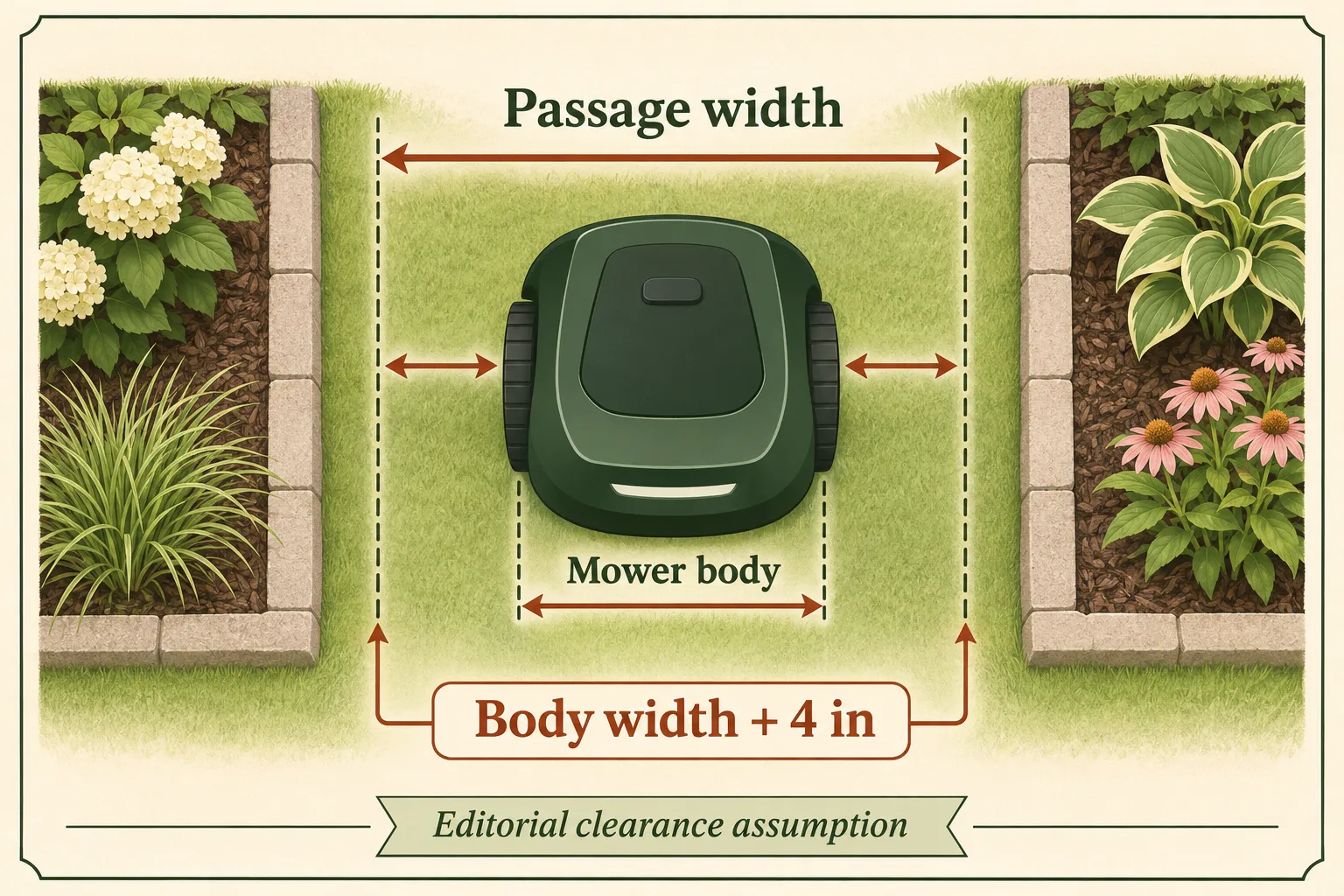
Gates and passages. Measure the narrowest gap the mower has to get through, whether it’s between zones or on the way to its dock. The finder requires that gap to be at least the mower’s body width plus 4 in. That 4 in allowance is our assumption, not a tested turning space. Where our data holds a maker’s own minimum passage width, the finder applies that too.
Check the maker’s stated minimum yourself, because it can be much wider than our rule. Navimow says the X4 needs a passage at least 39.4 in (100 cm) wide and 15.75 in (40 cm) high (Navimow prints the width as 39.31 in). With a 24 in body, our rule alone would accept a 28 in gap, 11 in narrower than Navimow’s minimum. Few models in our data have a maker minimum recorded yet; one is the Ecovacs GOAT A3000 LiDAR, at 31.4 in, converted from the 2.62 ft narrow-passage width on Ecovacs’ US product page (checked Nov 10, 2026). For the rest, the finder falls back on our 4 in rule. If the manual or support site gives a minimum, use that number.
Zones. If your lawn comes in separate pieces, enter how many there are and whether the mower can drive between them. The finder checks each model’s zone count and whether it has a documented way to move between zones. If it can’t drive between them, the finder warns that you’ll have to carry the mower, and no model can be a full match.
Other finder questions, from wire-free to budget
- Wire-free only. This box is checked by default, and while it’s checked, the finder removes boundary-wire models such as the Husqvarna 435X AWD. Uncheck it if you want those models included.
- Target cut height. This field is required. The finder compares the height you enter with each model’s published cutting range. The finder doesn’t choose a cutting height from your grass type.
- Cellular signal at the lawn and dock. Some mowers get their positioning corrections over a cellular network (network RTK). If you answer “No / uncertain signal”, the finder adds a warning to confirm an offline or local-RTK fallback and won’t count the model as a documented match. It does this only when the model’s navigation data contains “NetRTK”. Today that matches the Mammotion LUBA 3 AWD 3000, 5000, 3000H and 5000H records. It doesn’t flag models whose data uses a different label, such as Navimow’s “Network RTK.” So check cellular coverage yourself for any network-RTK model, whatever the maker calls it.
- Night mowing. We haven’t confirmed which exact models may run at night, so checking this box adds an unresolved check to every model.
- Children and pets. This adds a reminder, not a filter: keep children and pets out of the area while the mower is running, because obstacle detection isn’t supervision.
- Grass type. In the current finder, this changes one thing only: the eufy E18 is screened out for St. Augustine or Zoysia, based on brand guidance in our data.
- Budget. This filters on the dated price in our data, not today’s checkout price, and taxes and accessories are extra. Some of those prices are already out of date: when we checked on Nov 10, 2026, our data listed the Mammotion LUBA 3 AWD 3000 at $2,799, while Mammotion’s US store showed the LUBA 3 AWD 3000 Standard version at $1,999. Treat the budget filter as a rough guide, and check the current price with the seller.
Not sure what height to enter? Go by what your grass needs, not by what a mower happens to offer. Alabama Cooperative Extension recommends 1–2 in for Bermudagrass, centipedegrass and Zoysiagrass, 2–3½ in for tall fescue and 2½–4 in for St. Augustinegrass, mowing at the higher end in drought, heat or shade, and never removing more than a third of the blade at once. Then let the finder compare that height with each model’s published cutting range, and confirm the range yourself before you buy.
What “documented match” and “needs confirmation” mean
The finder sorts models into these groups, in this order, using the labels you’ll see on the page:
- Documented match: no failed check, nothing unknown, a US listing, and FCC authorization evidence on record for that exact model.
- Needs confirmation: nothing you entered rules it out, but at least one check is still unknown. These models appear under “Research candidates — checks still needed,” and the finder shows up to six.
- Show exclusions and missing evidence: a collapsed list of every model that isn’t a documented match, so it repeats the research candidates along with their unknowns. The group isn’t labeled “Excluded.” Besides the candidates, it holds models that fail a published limit, models listed as sold out at last check, and models screened out by the eufy grass rule.
Within each group, models are sorted by their dated price, lowest first. Commission plays no part in the order.
Sold-out models are excluded whatever the yard. If a model is “listed as sold out at last check,” it goes under “Show exclusions and missing evidence” even when your measurements would otherwise fit. That currently applies to a number of models in our data, including the Segway Navimow X430 and X450 and most of the LUBA 3 AWD records. Models still awaiting a US-availability check show “Current US availability” as missing.
Today, no model can appear as a documented match, whatever you enter. Every model in our data still shows its exact-model FCC authorization as unverified, and the finder won’t call anything a full match until that check is recorded. Combine that with the missing edge-slope data on most models, and that’s why the best result you’ll see is “needs confirmation.” Read it as “worth asking the seller about,” not as a recommendation to buy.
Why the finder checks FCC authorization
FCC status. As of Nov 10, 2026, the FCC’s Covered List includes foreign-produced advanced robotic devices unless the Department of War (DoW) has granted a Conditional Approval. The FCC’s Covered List FAQ (updated October 27, 2026) and its July 28, 2026 fact sheet (DOC-423682A1) both say this does not prohibit the import, sale or use of existing models the FCC previously authorized. The FAQ says it does not restrict consumers’ use of devices they already bought. The fact sheet says the action “does not impact a consumer’s continued use of devices they previously acquired,” and that it does not prevent retailers from continuing to sell, import or market previously approved models. The category was added by FCC public notice DA 26-786, released July 28, 2026, whose Appendix C sets out what counts as an advanced robotic device.
So the finder’s FCC check asks whether an FCC authorization has been matched to the exact model. Our research has since matched an FCC grant to a Navimow mower family, but the finder works from its data, and until those records are updated it still treats every model as unverified. Where we haven’t matched a model, its status is unverified. That is not a finding that it is unauthorized.
As of Nov 10, 2026, the FCC’s Conditional Approvals for advanced robotic devices include Husqvarna’s IQ robotic platforms (DA 26-957), Swap Robotics’ V7 robot and SunScout Holdings’ SunScout Eco, Pro and Promax Robotic Platforms (DA 26-1181). No entry on the list names a model covered on this page. Each model’s research profile carries its own dated FCC line.
When no model passes
Before you change any number, read the reasons under “Show exclusions and missing evidence.” Raising your slope or shrinking your lawn until something appears just hides the problem. A failed check usually points to one of a few questions worth asking a dealer or the maker:
- What’s the maximum slope at the boundary, not just in the work area?
- What’s the minimum passage width and height?
- Does the mower keep working if the satellite or cellular signal drops, and what’s the fallback?
- Is it allowed to run at night?
- What’s the exact US model number, and the FCC ID(s), including any radio module IDs, or SDoC compliance information?
If nothing fits after that, yours may not be a robot-mower yard. A dealer-installed system, a mowing service or the mower you already own can be the right answer. To compare the raw specs the finder uses, see the full sourced spec table. To budget beyond the purchase price, work out five-year running costs. If your lawn is about an acre, there’s also a shortlist of mowers for about an acre.
Spec-compared from manufacturer manuals, spec sheets and FCC records. We have not tested these mowers hands-on.
Related US listings
We may earn a commission if you buy through our links.
- Mammotion LUBA 3 AWD 3000 Check price at Amazon
- Lymow One Plus 10A Check price at Amazon
Sources
- Measuring the Area of a Home Lawn, HGIC 1220 (Clemson Cooperative Extension) ↗
- Determine Percent Slope and Angle of Slope (USGS) ↗
- Use the Level on iPhone (Apple Support) ↗
- Why is my Navimow GPS/RTK or positioning signal weak? (Navimow) ↗
- [Navimow X4] How much space should I leave for the Navimow X4 to pass through a channel? (Navimow Support) ↗
- Home Lawn Maintenance, ANR-0239 (Alabama Cooperative Extension System) ↗
- Automower 410 iQ (Husqvarna US) ↗
- Covered List FAQs: robots and inverters (FCC) ↗
- FACT SHEET: FCC Updates Covered List to Include Foreign-Produced Advanced Robotic Devices and Power Inverters (FCC, DOC-423682A1) ↗
- Covered List (FCC) ↗
- FCC DA 26-786 (Jul 28, 2026), incl. Appendix C definitions ↗